

Pair: QUEENS SOUTH AFRICA MEDAL 1899 three clasps "R of L., Trans & Laing’s" & KINGS SOUTH AFRICA medal with two clasps. Both medals impressed to “950 TPR: J. H. SCHUMEN B.M.I.” (36976 SCOUT: J. H. SCHUMEN. SCOTTISH HORSE ON KSA). An attempt to erase surname has been made (see explanation below).
Served with Colonial Scouts 22.12.99- 5.11.00
Bethune’s Mounted Infantry (number 950) 7.11.00-15.12.00
Menne’s Scouts (number 28) 16.12.00 – 3.12.01
Scottish Horse (number 36976) 10.1.02-31.5.02
Note: Medal roll confirms Jens Henrich Schumens service but his name is continuously misspelt and he appears as many variations “Gens, Jas, Jos, James and Schuman, Schumman, Schummen” and it is for this reason we can see why he has clearly erased his surname off the medals and the first initial is altered to a J on his KSA. Luckily his service number and all other details have been left alone and the medal rolls link and confirm his group. Outstanding service.
Apart from naming mentioned, VF SOLD
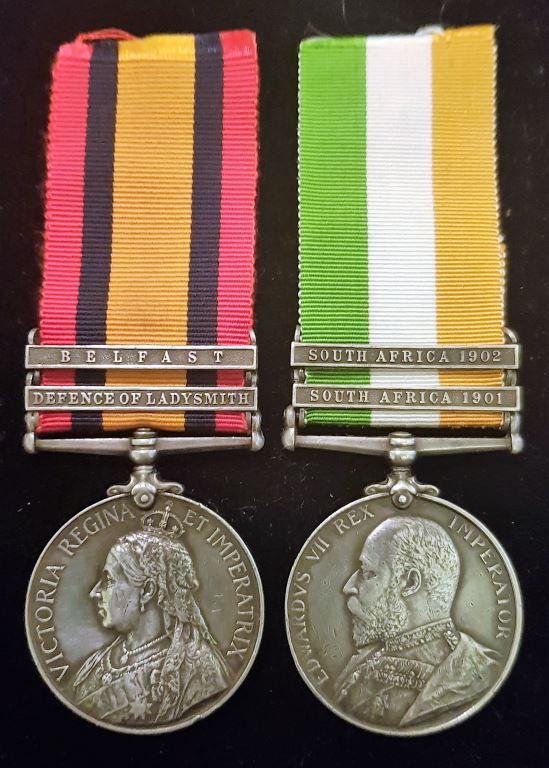

Pair: QUEENS SOUTH AFRICA MEDAL 1899 two clasps "Belfast & Defence of Ladysmith", KSA two clasps.5290 PTE H. MARSLAND MANCHESTER REGT
VF $675
![Pair: Queen’s South Africa 1899-1902, 2 clasps, Natal, Transvaal (874 Pte C. [sic] Elliott. Durban L.I.); Natal 1906, 1 clasp, 1906 (Tpr: C. E. Elliott, Natal Police.)](http://www.jbma.com.au/cdn/shop/products/elliott.jpg?v=1634514036)
![Pair: Queen’s South Africa 1899-1902, 2 clasps, Natal, Transvaal (874 Pte C. [sic] Elliott. Durban L.I.); Natal 1906, 1 clasp, 1906 (Tpr: C. E. Elliott, Natal Police.)](http://www.jbma.com.au/cdn/shop/products/elliott_60x.jpg?v=1634514036)
Pair: Queen’s South Africa 1899-1902, 2 clasps, Natal, Transvaal (874 Pte C. [sic] Elliott. Durban L.I.); Natal 1906, 1 clasp, 1906 (Tpr: C. E. Elliott, Natal Police.)
Both mounted with top riband buckle, very fine $695


Pair: Queen’s South Africa 1899-1902, 4 clasps, “Belmont, Modder River, Orange Free State & Johannesburg” 12351 Dr. C. R. Oliver, A.S.C.; King’s South Africa 1901-02, 2 clasps 12351 Dvr. C. Oliver, A.S.C.
Note: Charles Robert Oliver was born in Church Oakley, Basingstoke, Hampshire. A Labourer by occupation, he attested for the Army Service Corps at Aldershot on 13 August 1895, aged 21 years, 11 months. With them he served in South Africa, October 1899-April 1905 and Gibraltar, September 1910-February 1911. Discharged medically unfit on the 7th March 1911. With copied service papers
Contact marks, minor edge bruising, nearly very fine SOLD
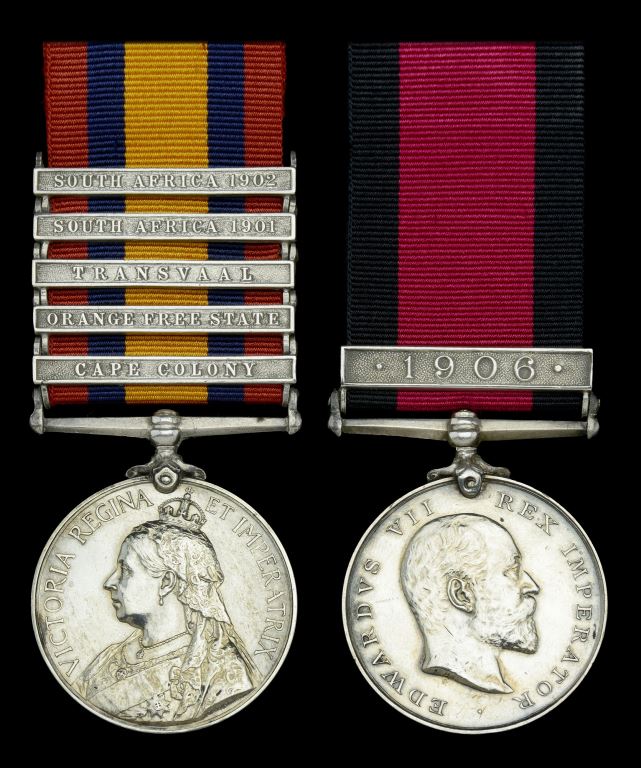

Pair: Queen’s South Africa 1899-1902, 5 clasps, Cape Colony, Orange Free State, Transvaal, South Africa 1901, South Africa 1902 (1707 Tpr: E. C. Holt. S.A.C.); Natal 1906, 1 clasp, 1906 (Cpl: E. C. Holt, Natal Rangers.)
Eric Charles Holt was born in London in 1877 and attested for the South African Constabulary at Westminster on 11 October 1901.
Sold with copied attestation form and medal roll extracts.
Minor edge bruising to latter, good very fine $875


Pair: Queen’s South Africa 1899-1902, 5 clasps, “Cape Colony, Tugela Heights, Relief of Ladysmith, Transvaal & Laings Nek ”1106 PTE. R. GLADWIN, RIFLE BRIGADE.; King’s South Africa 1901-02, 2 clasps 1106 PTE. R. GLADWIN, RIFLE BRIGADE
Very fine SOLD
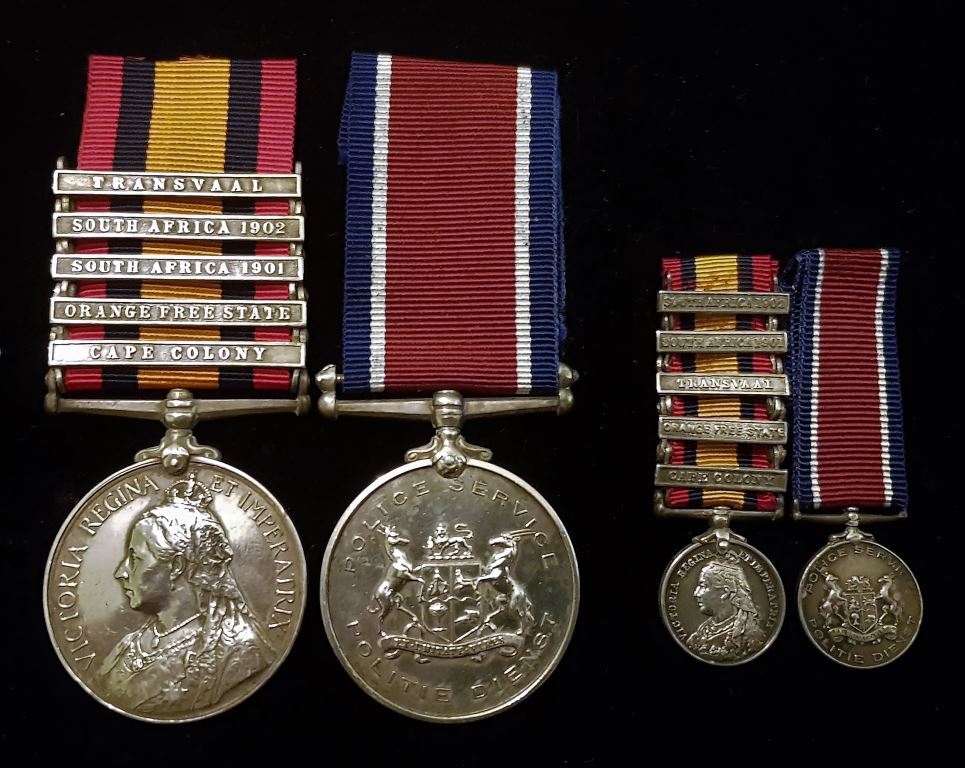

Pair: Queen’s South Africa 1899-1902, five clasps, “Cape Colony, Orange Free State, South Africa 1901, South Africa 1902 & Transvaal” correctly impressed 2809 3rd CL TPR W. McGILLICUDDY S.A.C. & South African Police Faithfull Service Medal impressed NC2146 (M) 1/C SERGEANT W. S. McGILLICUDDY
Note: The Transvaal clasp is a later attachment and not on his medal roll. Comes with nice period silver miniatures
GD VF $725
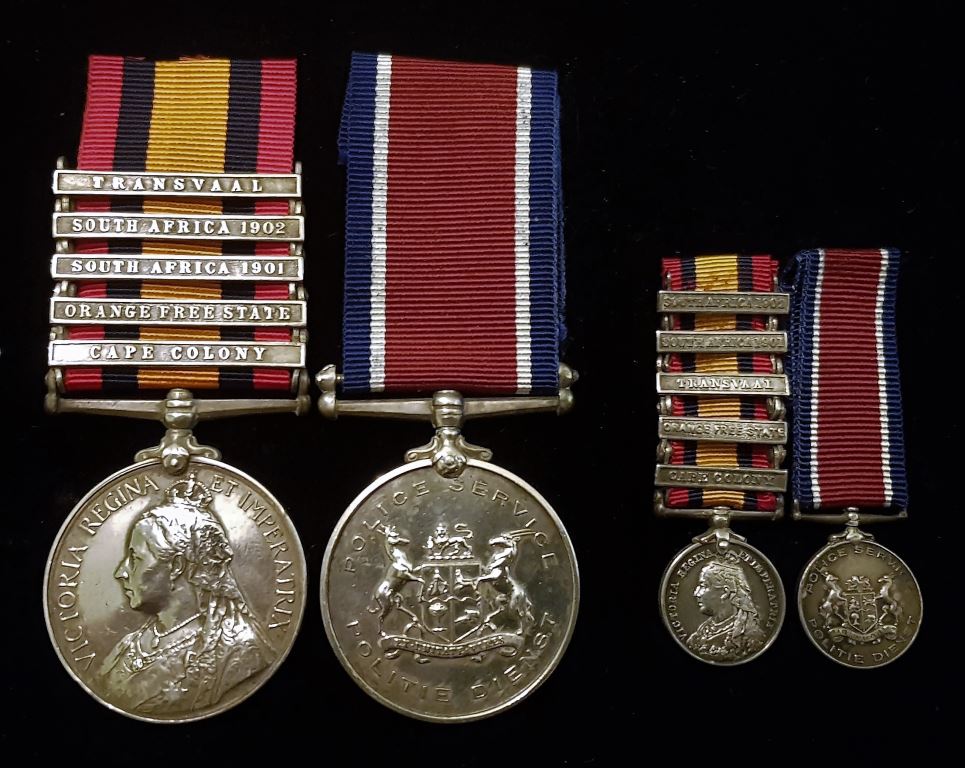

Pair: Queen’s South Africa 1899-1902, five clasps, “Cape Colony, Orange Free State, South Africa 1901, South Africa 1902 & Transvaal” correctly impressed 2809 3rd CL TPR W. McGILLICUDDY S.A.C. & South African Police Faithfull Service Medal impressed NC2146 (M) 1/C SERGEANT W. S. McGILLICUDDY
Note: The Transvaal clasp is a later attachment and not on his medal roll. Comes with nice period silver miniatures
GD VF $725


Pair: Queen’s South Africa Medal 1899 with three clasps "CC, OFS, T.” and Kings South Africa medal with two clasps “S.A 1901 & S.A. 1902” both medals correctly impressed to 2437 Pte C. King Suffolk Rgt.
Near VF $525


Pair: Queen’s Sudan 1896-98 3955 PTE N. WILDE 1/R. War. R. (small initial correction "V" to "N"), Khedive’s Sudan 1896-1908, 2 clasps, “The Atbara, Khartoum” 3955 PRIVATE. N. WILDE 1st ROY WARWICKSHIRE. REGT
Slight wear to naming (90 % readable), otherwise VF SOLD


Pair: Rhodesian General Service Medal and Zimbabwe Independence Medal. GSM correctly impressed 645847 TPR N. DENHERE. Independence Medal numbered 17047
Comes with wings attached to medals, along with Laminated Certificate of Service with the Selous Scouts of the Rhodesian Army.
Note: a period roll titled “Secret” notes rank as Corporal with 9 Tp, 26th March 1979.
A very nice and desirable group to an original Selous Scout.
VF SOLD


Pair: Royal Navy L.S. & G.C., G.V.R., 3rd issue, coinage head (2) J.61078 G. W. Baldwin. Tel. H.M.S. Pembroke; J.61078 G. W. Baldwin. Tel. H.M.S. Pembroke both impressed in small sans serif capitals in exactly the same style, nearly very fine and better and a rare double issue (2)
George William Baldwin was born in West Ham, Essex, on 1 November 1900 and joined the Royal Navy as a Boy Second Class on 30 October 1916. Awarded his Long Service and Good Conduct Medal on 9 November 1933, he was advanced Leading Telegraphist on 1 March 1936, and after seeing service during the Second World War was released in the rank of Petty Officer Telegraphist on 12 September 1945.
near EF $385


Pair: South Africa 1877-79, 1 clasp, “1879 “ 8146, SERGT. J. McDONALD, R. E. Army L.S. & G.C., V.R. 8146. CD. SGT. MAJ: E. J McDONALD, R. E.
Note: Comes with service record stating “Received Gun Shot wound of thigh in a false alarm, at the camp of the 2nd Division at Nondweni S. Africa, on the 6th June 1879”
SGT McDonald belonged to the 5th Company Royal Engineers under LT Chard VC
VF SOLD



Pair: South Africa 1879 one clasp 1877-8 correctly engraved in typical style, Pte. D. Cameron Queenstown Vol: Cont gt.
Second medal one clasp 1877-78-79 re-named, D. Cameron Cape Town Volunteers.
The first medal is fully confirmed with the second being self-awarded. Perhaps he felt the clasp with 1879 was a true representation of his service.
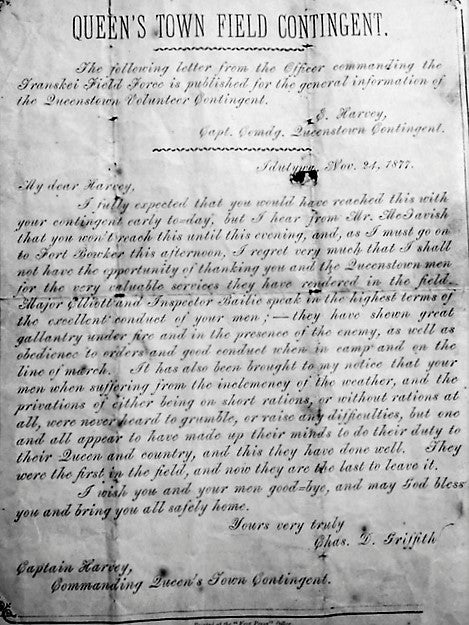
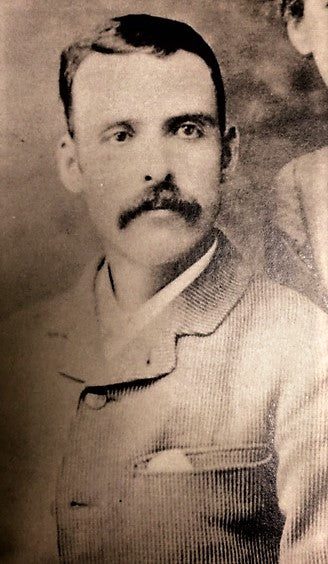
These medals came direct from the family and includes a photo of the recipient plus an original printed flyer praising the Queens Town Volunteers for “they have shown great gallantry under fire and in the presence of the enemy”. Signed by the Officer Commanding the Transkei Field Force Captain Harvey.
An interesting pair in Gd VF $1850


Pair: Vietnam Medal and Vietnam Star with 1960- clasp to A56467 WELLS R. L. with both medals correctly Airforce style named.
The Vietnam Veterans Nominal Roll states the following;
Name: Raymond Lionel Wells
Date of Birth: 15/11/1943
Place of Birth: Perth, Western Australia
Service: RAAF
Rank: Corporal
Served with Headquarters, Australian Force Vietnam (RAAF Element) from 12th June 1966 to 15th May 1967
VF $525
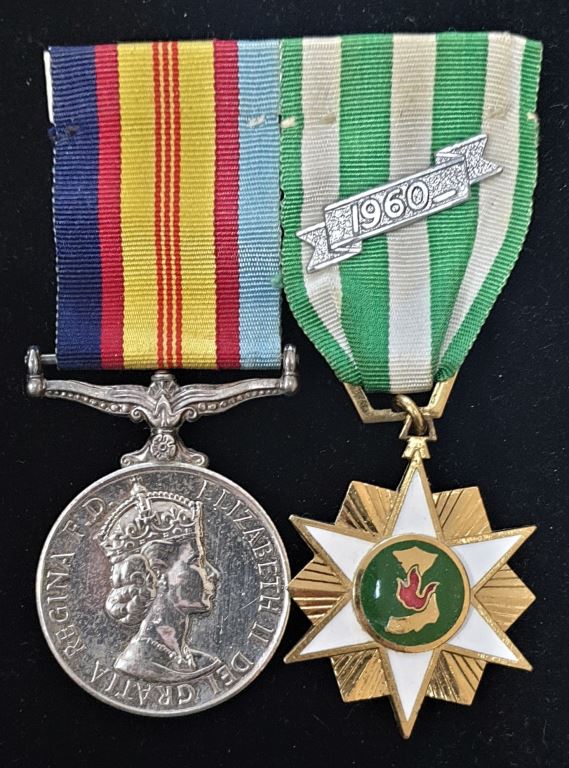

Pair: Vietnam Medal and Vietnam Star with 1960- clasp. The Vietnam medal is correctly impressed to 18821 K. J. Pardella and the Vietnam Star is correctly engraved.
Kevin John Peter Pardella joined the Army Apprentice School (18th intake), Vehicle Mechanic on trade as part of the Royal Corps of Australian Electrical and Mechanical Engineers in Queensland and served with the 2nd Battalion Royal Australian Regiment in Vietnam from 19th May 1967 to 13th June 1968. After discharge noted as residing in Victoria.
VF $575


Pair: Vietnam Medal and Vietnam Star with 1960- clasp. The Vietnam medal is correctly impressed to 44183 R. F. WILHELM and the Vietnam Star has the correct first type engraving.
Private Wilhelm was in Vietnam from September 1967 to April 1968 with 7 RAR. A nice early Vietnam infantry group with no chips in the enamel as so many have.
Note. 7 RAR was present at the TET offensive in 1968.
VF SOLD


Pair: War Medal and African Service Medal. Both medals correctly named to 80708 A. J. BEKKER
Note: Further research required
VF $75
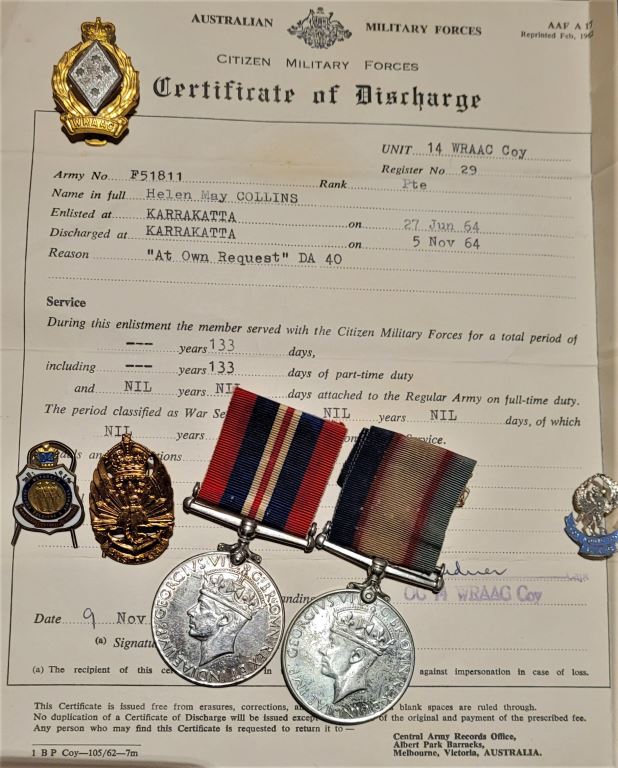

Pair: War Medal and Australian Service Medal. Both medals correctly named to 80636 H. C. COLLINS
At the time of listing these medals Corporal Horace Cecil Collins’s service records were still sealed. The following was taken from the WW2 nominal roll;
Place of birth Coolup, Western Australia
Enlisted 27th May 1942 into the Royal Australian Air Force
Discharged 25th November 1945
Unit on discharge listed as “4 CENTRAL RECOVERY COMPANY”
Note: Further research required
Comes with badges and 1964 Discharge certificate for a Private Helen May Collins who served as F51811 with the 14th WRAAC (Karrakatta).
Near EF $225


Pair: War Medal and Australian Service Medal. Both medals correctly named to WX30071 H. E. WALTERS
At the time of listing these medals Private Herbert Edward Walter’s service records were still sealed. The following was taken from the WW2 nominal roll;
Enlisted 15th July 1942 into the 16th Battalion Australian Army at Bellevue, Western Australia
Discharged 3rd November 1944 (possibly injury?)
Further research required
VF SOLD


Pair: War Medal, GSM clasp Palestine 1945-48 14036295 Pte R J Catley RMP
VF $175


Pair; QUEENS SUDAN 1896-98 & KEDIVES SUDAN 1896-1908 one clasp "HAFIR" both engraved 3415 Pte.C.Ford. 1.N.STAFF.Rgt.
VF SOLD


Pair: Captain C. G. Collins, Cameron Highlanders, who commanded the Howe Battalion of the Royal Naval Division throughout the Gallipoli campaign and ‘led a dashing life that made the romantic heroes of fiction seem pale’
Queen’s South Africa 1899-1902, 4 clasps, Cape Colony, Orange Free State, Johannesburg, Diamond Hill (Lieut. C. G. Collins. 1/Camn. Hdrs.) engraved naming; King’s South Africa 1901-02, 2 clasps, South Africa 1901, South Africa 1902 (Lieut. C. G. Collins. Cam. Hrs.) engraved naming,
Charles Glen Collins was born in 1880, the grandson of William Collins who founded the well-known publishing firm of the same name. He was educated at Cheltenham College, where he was an outstanding sportsman, and the Royal Military College Sandhurst. Commissioned into the Queen’s Own Cameron Highlanders on 14 September 1898, he joined his regiment in Cairo after the conclusion of the Sudan campaign. His colourful unpublished memoirs in the National Army Museum (Archives 2007-07-02) give a full account of the pleasures of peacetime soldiering in a crack Highland regiment. He played on the regimental polo team, shot duck and left detailed accounts of regimental customs such as dinner nights and subaltern’s court martials. His time in Egypt was not without incident. He was challenged to a duel in Alexandria after an altercation over a Hungarian dancer and he was nearly lynched in Marseilles on his way home on leave. Having pushed a drunk cab driver, who fell over, word spread along the corniche that an English officer had killed a Frenchman. Memories of the Fashoda incident were fresh and a mob soon attacked the Hotel De Noailles where Collins was staying and in his pyjamas by that time.
‘Stones and missiles were every moment breaking the windows in the hotel. The affair of the drunken cabman was beginning to assume serious proportions. At the same time loud knocking at my door announced the arrival of the hotel manager who, badly frightened, very strongly suggested that I should go out and quiet the mob. I saw that this man had completely lost his head so I slammed the door and locked it in his face. I then pushed a large wardrobe in front of the door, drew my Claymore, which happened to be among my hand luggage and decided to put up the best fight possible under the circumstances. I then saw through the window that a large body of police, both on horse and on foot, had arrived. A few minutes later, imperative orders to open my door, with the repeated mention of “Police!” caused me to push aside the wardrobe and admit a Captain of the Gendarmes. He also appeared somewhat excited so I decided it would be wise to start off by handing him a hundred franc note.’
The Boer War, Kitchener’s Fighting Scouts and Mentioned in Despatches
Collins survived the ordeal and was later recalled from leave in England to re-join his regiment in Cairo. It was held in readiness for immediate embarkation for South Africa. The 1st Battalion Cameron Highlanders arrived in South Africa on 23 March 1900 and fought their way to Pretoria as part of the 21st Brigade in General Ian Hamilton’s force. Their exploits were well recorded by Winston Churchill in his book Ian Hamilton’s March. They covered over 2,500 miles on foot. For his part, Collins noted that Churchill and the Duke of Marlborough, on the staff, were billeted next to their lines: ‘We were always entertained by observing that the Duke invariably did all the dirty work: pitching and striking their bivouac, cooking and cleaning the pots and pans while his cousin smoked his pipe and freely criticised him.’
On 10 June 1901, Collins was appointed Adjutant of 1st Kitchener’s Fighting Scouts with the rank of local Captain. He was only twenty-one years old. Kitchener’s Fighting Scouts was an irregular regiment of volunteers raised in December 1900 and commanded by the legendary colonial warrior, Johan Colenbrander, called ‘The White Whirlwind’ by the Zulus. They fought the Boers, General Beyers and his commando especially, in the harsh Northern Transvaal. The officers and Troopers were some of the toughest Rhodesians, South Africans, Australians and Americans. They were notoriously averse to the discipline exerted by a regular Adjutant but which was required if the regiment was not to run amok, as happened to ‘Breaker’ Morant and the Bushveldt Carbineers operating in the same area. Collins’s memoirs detail some of the incidents he dealt with, including the execution of three captured Boers who were dressed in British uniform and had lured some of the KFS into a lethal ambush.
Colenbrander and his men captured many Boers, their laagers, wagons and cattle but not Beyers during the guerrilla war. Colenbrander recommended Collins to Lord Kitchener for an award on 23 December 1901: ‘Capt. C. G. Collins, S.O. and Adjt. 1st K.F.S. (1st Cameron Highlanders). To whom as my Staff Officer I have always left the organisational work of the Column and to whose capability I attribute in a great part captures and successes we have been able to make’; and again on 28 April 1902: ‘Adjutant 1st K.F.S. and Staff Officer to my column to whose untiring energy and most able management I owe in great measure any success we may have accomplished. To this officer I have on all occasions entrusted the whole of the organisation of the Column, and his assistance to me has always been of the most ready and practical order’ (The National Archives, Kew, WO108/140 & 141). Collins was Mentioned in Despatches in Kitchener’s final despatches (London Gazette 29 July 1902).
Balmoral, bankruptcy, marriage and divorce in the U.S.’s ‘Gilded Age’
Collins was chosen as one of the three Cameron officers of the first King’s Guard to be mounted at Balmoral during King Edward VII’s reign. His memoirs contain much detail about life at Balmoral and the Royal family, some of it repeated in a series of articles about Collins published in the book Mississippi Gumbo by Bob Jones in 2003. Collins’s time at Balmoral got off to a shaky start when he nearly crashed his newly acquired car, a Panhard Levassor, into a coach containing the Princess of Wales and her five children including the future Kings Edward VIII and George VI. He was ordered to garage the car for the remainder of his duty.
Collins was an inveterate gambler, at Monte Carlo and on the racecourse. He later attributed his financial difficulties to backing bills for his friend Charles Innes-Ker, a Gentleman Usher to the King. Whatever the cause, according to Collins it was ill-health, he resigned his commission in February 1904 before he was declared bankrupt in September 1904. By this stage he was in New York and conspicuous as a polo player and charming member of the Gilded Age set which included his friends the Vanderbilts, Goulds and Belmonts. In April 1904 he had married the American heiress Nathalie Schenck, the ‘Granddaughter of Brooklyn’. The marriage was short lived, not least because of his gambling. He lost a quarter of a million dollars on Boxing Day night in December 1904 playing baccarat at the Khedieval Club in Cairo. She divorced him in 1905.
Collins spent the next ten years in recurrent financial difficulty in the United States, often reported in the U.S. papers. He set out to marry an heiress. In 1911 he was engaged to be married to Clara Parks, stepdaughter of the millionaire John H. Parks. The engagement ended when Princess Zoltykoff, the former burlesque dancer Ethel Clinton, accused him publicly of having appropriated two valuable Chinese vases from her in London seven years earlier. Soon afterwards, Collins declared personal bankruptcy in New York with debts of $414,000 (the equivalent of $10 million today) and 148 personal creditors in the United States and Europe including members of his family and Cartier jewellers in Paris. It was reported that his clothes cost $20,000 a year. The scale of the bankruptcy merited mention in The Wall Street Journal.
In 1914 he attempted four times to elope with Amelia, the 30-something year-old daughter of the sewing machine manufacturer and millionaire Samuel H. Wheeler. Her incensed father hired Pinkerton detectives to stalk his every move. They managed to abort the third attempt, during which Collins had disguised himself as an old woman. Amelia was then locked in a house in Chicago with three maiden aunts. After corresponding through her hairdresser, they succeeded in August 1914 to elope at the fourth attempt. They roused a retired clergyman, who was working as a postman, out of his bed at midnight to marry them.
Command of the Howe Battalion in Gallipoli campaign - twice Mentioned in Despatches
Collins returned to England soon after and went to see Lord Kitchener at the War Office in London. He was made a Temporary Captain dated 7 October 1914 and embarked on recruiting duties in Chelsea:
‘At the end of a week I was bored to death with my job and hated the sight of the poster “Your King and Country need you.” Every few days I was called over to the War Office for a conference with [Captain] Whiffen. Early in September, I almost collided with the preoccupied and harassed looking First Lord of the Admiralty, Winston Churchill, an old fellow campaigner of Egypt, South Africa, and the polo field.
“Hello, Colenso. What the devil are you doing here?”
“Rotten job, helping to raise Kitchener’s hundred thousand.”
“Well, I’m raising a division, like to join us?” Like a flash came,
“Nothing better.”
“All right then, I’d like to have you. I’m on my way to arrange some swaps with K. You know Arnold Quilter [Lt.-Col. J. A. C. Quilter], don’t you? Go and see him and he will arrange everything.”
In this totally unexpected manner I found myself within a week transferred from a Staff Captaincy in the Army to the rank of Commander in the Navy with the post of Second-in-Command if the “Hood” Battalion of the Royal Naval Division.’
Collins was appointed Temporary Lieutenant-Commander in the R.N.V.R. on 26 October 1914. The Hood Battalion was commanded by Quilter and included the Prime Minister’s son, Arthur Asquith, and Rupert Brooke as officers amongst others. However, Collins, still only 34, was soon appointed as the Commanding Officer of the Howe Battalion with the rank of Temporary Commander on 24 December 1914, following the resignation of its previous C.O. after the Antwerp debacle. Commanding Officers were later transferred to the Royal Marines and Collins was gazetted as a Temporary Lieutenant-Colonel on 4 February 1915, though he insisted on wearing his Cameron glengarry. Collins trained his battalion, obtained some regular officers for it through a direct approach to the Prime Minister’s wife, paid for a band and pipers from his own pocket, and heard about the forthcoming Gallipoli campaign at a dinner at Churchill’s house along with the other Commanding Officers of the Royal Naval Division.
The Howe Battalion left Blandford Camp on 20 February 1915 and embarked on the Royal George for the Mediterranean. After a spell in Egypt, Collins led his battalion ashore on the Gallipoli peninsula on the morning of 26 April and they fought their way forwards in small, isolated parties. They repulsed a Turkish attack on the 30 April to 1 May. ‘I will never forget that night so long as I live. Desperate hand-to-hand fighting lasted until dawn. In several places the British line was broken only to be recaptured by bayonet charges, with terrific cost of life’, wrote Collins. A resulting order for a counter-attack to Krithia by the Corps Commander led to further loss of life – ‘I had over half my Regiment wiped out by casualties during the first five weeks ashore. The worst was yet to come. However, drafts of new officers and men were landed nightly from Mudros to replace the casualties.’
The Howe Battalion took part in the disastrous attack, the Third Battle of Krithia, 4 June 1915 alongside the Hood, Anson and newly arrived Collingwood Battalions. 800 men of the Howe Battalion left their trenches at noon after a preliminary bombardment and attacked the Turkish trenches 250 and 350 yards to their front. Collins sent them forward in three waves, rather than the ordered two, keeping one in reserve. The trenches were taken but the French attack on the right flank was beaten back. The Turkish machine gunners in the uncaptured trenches were able to bring enfilade fire onto the trenches that had been taken. Commanding his men from the captured trenches, Collins ordered a withdrawal back to their own trenches. Within an hour, the Howe Battalion had suffered 410 casualties: 14 officers and 279 men killed and the balance wounded. The other Battalions of the 2nd Brigade of the Royal Naval Division fared even worse. The remainder of the Gallipoli campaign descended into trench warfare. The evacuation of the Gallipoli Peninsula took place on 7 January 1916. Collins reckoned that he was the only one of 96 Commanding Officers to survive from the landings to the evacuation without being killed, captured, evacuated through wounds or sickness or sacked. He was twice Mentioned in Despatches, by General Sir Ian Hamilton (London Gazette 5 November 1915), and his successor General Sir Charles Munro (London Gazette 12 July 1916). Later, Collins was to claim that he had been awarded the Légion d’Honneur and cited for the C.M.G. Owing to subsequent events he did not even receive his First World War campaign medals.
Resignation, arrest, imprisonment and extradition to India from the U.S.
Collins resigned his command and commission on 17 May 1916 after the return of the Howe Battalion to England. It is not clear whether this was due to his undischarged bankruptcy or because he had embarked on an affair with Elsie Muntz, the wife of a brother officer in the Royal Naval Division. He appeared in two divorce cases, the Muntz’s and his own, in 1917 and 1918. In 1917 he travelled to India with Mrs Muntz and a Mrs Olga Olsen. He bought £8,000 pounds worth of pearls from a Bombay jeweller but his drafts were not honoured. The Indian jewellers sought his extradition to Bombay to face trial for fraud. With the help of the British Embassy in New York, he was found and arrested in New Orleans. When the U.S. Marshals arrived at his ‘death-bed’ in a New York hospital to serve his extradition papers he had disappeared. He was re-arrested in New Orleans and locked up in the House of Detention.
For the next five years Collins fought the longest extradition battle in US legal history. It became an international cause célèbre. For three of them he was kept in jail in New Orleans, along with the most magnificent wardrobe the jailers had ever seen. They ran his bets to the bookies and went sailing with him on the yacht he bought after winning $100,000 at the races. For two of the five years, a British police officer waited in New Orleans to escort him back to London and on to Bombay. On one occasion Collins escaped from the House of Detention taking the key to his cell as a souvenir. U.S. Marshals captured him trying to board a steamer to London.
Eventually, the future U.S. President William H. Taft ruled that he should be extradited. At that stage Collins was living on bail in the French Quarter in New Orleans where he had become friends with the young author William Faulkner. He featured as Major Ayers in William Faulkner’s New Orleans novel Mosquitoes. Collins was the subject of many newspaper articles, with headlines such as ‘His Love Charmed. Dashing Lieutenant Colonel a Favorite with Women’ (The Salina Evening Journal, Kansas, 16 October 1918), ‘Capt. Glen Collins, Hero – and Rascal? The Strange Jekyll and Hyde Career of a Brave and Distinguished Officer Who Married Into the Fashionable 400 and Is Now to be Tried as Adventurer and Swindler (The Washington Times, 5 January 1919) and ‘Fresh Adventure Ahead of Collins, Soldier of Fortune – What’s that ‘something about’ him? – He Has Looks, Brains, Wit, Courage, Luck and Charm, Yet Court Says he Must Return to India Under Serious Charges’ (The Evening World, New York, 10 May 1921). Accompanied by a recently arrived British police officer he left New Orleans by boat in 1923. His friends organised a band to see him off. He stood trial twice in the High Court of Bombay. Both times he was acquitted. He returned to New Orleans in 1924 on a slow boat home, receiving a rapturous welcome from friends and another band.
Collins lived reasonably quietly in New Orleans for the next fifteen years, marrying once more. He died in 1939. When told of his terminal illness he is reported to have remarked, ‘Life owes me nothing. I have tasted all of its joys.’
This is a story that great movies are made of and a classic example of why medal collectors use the expression: “the man behind the medal”.
Edge nick to QSA, otherwise about extremely fine and the recipient’s only issued medals due to his WW1 trio having never been claimed $5650


Passport photo of Thomas McConville and his wife
Four: R.Q.M.S. Thomas McConville M.S.M. Royal Irish Fusiliers
1914-15 Star (14516 SJT T. McCONVILLE. R. IR. FUS); British War (14516 SJT T. McCONVILLE. R. IR. FUS); VICTORY MEDAL (14516 SJT C. McCONVILLE. R. IR. FUS); Meritorious Service Medal, G.V.R., 1st issue (14516 C.Q.M. SJT T. McCONVILLE 9/R. IR. FUS). There is a minor initial error on the Victory Medal, but all surrounding information including service number is the same.
M.S.M. London Gazette 18 January 1919.
Thomas McConville was born on the 9th August 1895 in Co. Armagh, Northern Ireland and enlisted with the Royal Irish Fusiliers in 1915, serving with the 9th Battalion (Lurgan) during the Great War. A Genealogy extract on Lurgan has his final rank as Regimental Quartermaster showing the following “McConville, Thomas, 120, Victoria Street, R.Q.M.S., 9th R.I.F., M.S.M”. He and his wife along with their baby daughter migrated to Australia in 1926.
Nearly extremely fine SOLD


