


Grenadier of the Imperial Old Guard. Patinated bronze.
A rather nice 19th Century bronze of a Grenadier in the French Imperial Old Guard. The overall height being 260 CM.
Very Good Condition $950


An emotional and Historical WW2 relic of immense importance to the history of Ukraine being a 19th century Bronze Bust of Napoleon by Antoine Denis Chaudet, with a rear hair ribbon with shoulder drapes of the type used by Houdon.
Its history is as follows. Prior to the well-known “Death Match” in which 8 Ukrainian footballers were arrested by the Nazi’s, several of the lead up matches were played in June 1942. The Germans wanting a suitable Trophy, liberated this Bronze from a Ukrainian Institution. They had the front of the socle polished and engraved as follows.
FUSSBALL TURNIER
CHARKOW JUNI 1942
DEM SIEGER
Under German occupation, all Soviet organizations and clubs were dissolved. By the end of 1941, German administration allowed newly formed Ukrainian sport clubs. In January 1942, football trainer and sport reporter Georgi Dmitrievich Shvetsov founded the club Rukh (Movement). He tried to engage the best players in Kyiv.
But most of the former Dynamo players, among them the very popular goalkeeper Trusevich, did not want to play in Rukh, probably because they took Shvetsov for a collaborator. Trusevich found a job in the Bakery No. 1 which guaranteed their workers and their families normal supplies of food. More former Dynamo players found jobs in the bakery. The German director Joseph Kordik, an engineer from Moravia, encouraged them to form a football team: FC Start. After World War II Kordik declared to the NKVD that in reality, he was Czech, not German.
Three players of the former club Lokomotiv Kyiv were incorporated into the new team. Four former players who were directly submitted to the German administration also played for Start: three Ukrainian policemen and one engine driver of the German Railways Reichsbahn in Kyiv. None amongst the Start players had played for the Dynamo team in the years immediately before the war, although some of them had left the club only a couple of years before.
Matches in June and July 1942
Seven Start matches are documented for June and July 1942: against the Ukrainian teams Rukh and Sport, three Hungarian military teams, a team of the German artillery and the German railway team RSG. FC Start won all these matches, scoring 37 goals in total and conceding only 8. There is an enormous amount of material dealing with the “Death Match on the internet.
Some damage to the nose and chin of the Bronze otherwise good condition overall.
POA
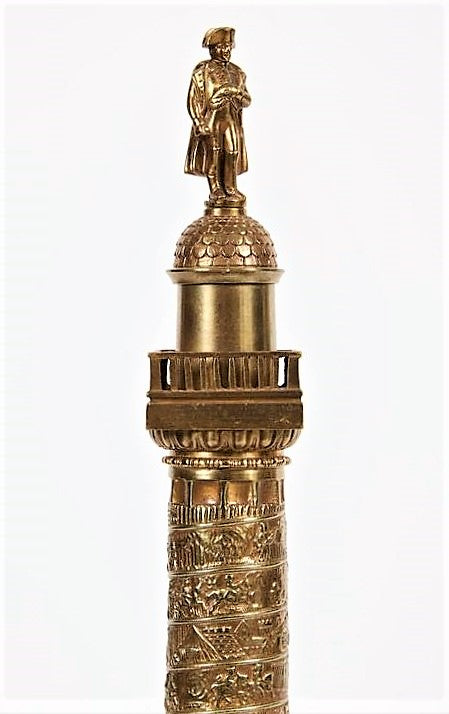

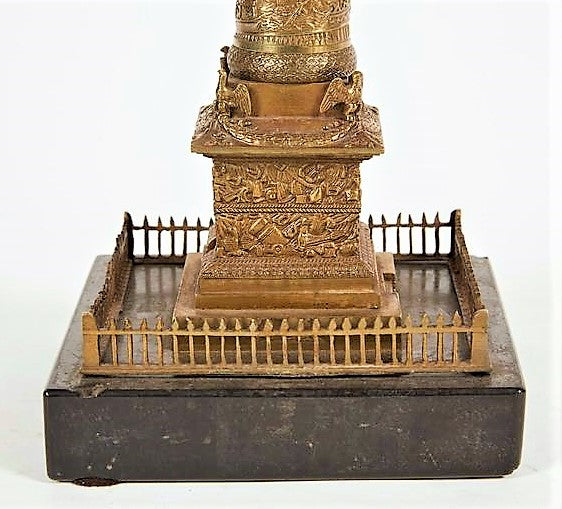

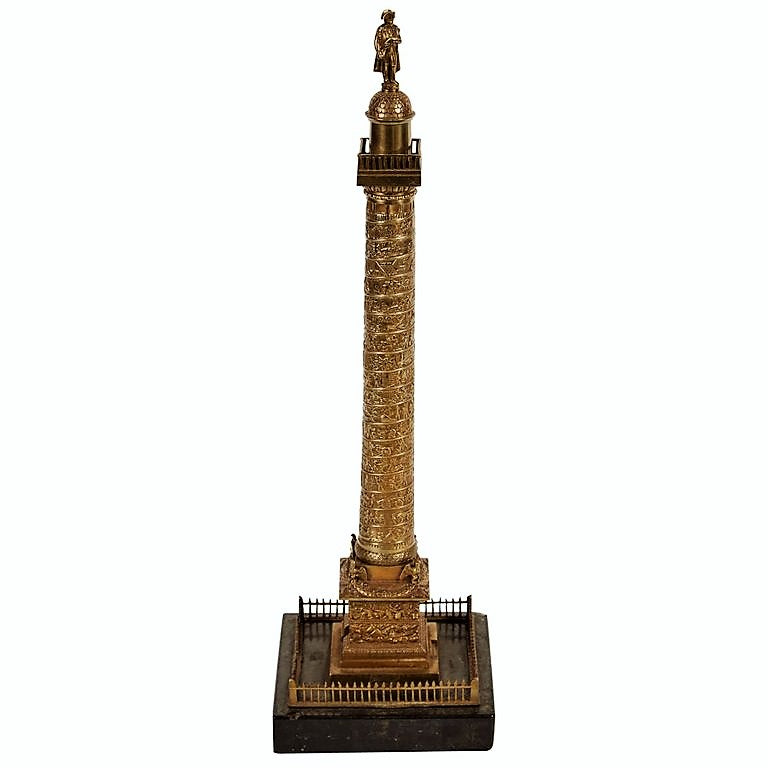

A 19th century gilt bronze model of the Napoleon Vendome Column, Paris. Officially titled the “Colonne de la Grande Armée” it was seen as the most important symbol of Paris during the 19th century and its complex history explains why.
In 1803 the First Consul confirmed the plan to erect a column in Vendôme equal to that of the Roman column of Trajan. The columns design was undertaken by Lepère and Gondoin, made from melting 1200 Austrian and Russian artillery pieces won in the recent campaigns. The inscription at the base reads: ‘Monument erected to the glory of Napoleon the Great’s Grande Armée, begun on 25 August 1806 and finished 15 August 1810’.
The column itself comprises of a stone core enrobed with 425 bronze plaques fixed to the stone with pins. Designed by Bergeret the 280 metre-long frieze (or plaques), wrap around the column depicting the major events of the recent campaign. The column begins at the camp in Boulogne and ends with the return of the Emperor and his guard in 1806. Sculptures such as Boizot, Bosio, Bartolini, Ramey, Rude, Corbet, Clodion and Ruxthiel were all commissioned to execute this frieze.
Initially the column was crowned with a statue by Chaudet of The Emperor in Roman dress but was taken down by the Allies in 1814 and replaced by a flag bearing the fleurs de lys. It was then under the July Monarchy a further replacement statue was made by Seurre showing Napoleon as the ‘Little Corporal’ (a statue today held in the Invalides). Eventually during the Second Empire, a copy of Chaudet’s initial statue designed by Dumont was hoisted to the top of the column to replace the unpopular “Little Corporal” by Seurre.
The column was targeted one final time and dismantled during the “Commune” under the direction of Gustave Courbet due to it being a symbol of militarism and imperialism. Then in 1873 it was finally re-erected and restored to its former glory with Courbet being ordered to pay the costs for this himself, which payment was received as Courbet died shortly after.
This stunning bronze manages to transfer the history, skill and pride all associated to the original column with its flawless attention to detail. A beautiful, well executed bronze period piece.
18 in. (46cm) high $3500


A fine early Military Anglo Colonial Secretaire Campaign Chest circa 1830. H. 1040 W. 445 L. 915. One piece with original brass carry handles.
Despite the acknowledged down turn in “brown furniture”, this can not be said about Campaign furniture and what makes this so interesting is its age with the tell tail flared sides on the handle back plates. Strong possibility this has come to WA via an early British Officer to the Colony.
RARE. Good Condition $3850


A fine early Military Anglo Colonial Campaign Chest circa 1825. H. 1020 W. 440. L 1015. An earlier two-part chest displaying the same early flared handles but what possibly makes this earlier than the other, is the top wrap around brass corner protectors are basic wrap around strips as opposed to the full corner devices. Another strong possibility of a British Officer in the Colony of WA.
RARE. Good Condition $3850.


A set of Fire iron related items, comprising Poker/tongs made from two French Gras Bayonets plus two fire dogs also made from French Gras Bayonets.
Believed to be made in the late 1920’s as fundraising for war memorials and museums. Although I have had pokers, shovels before, I Have never had a set of dogs in 50 years.
Good condition $685
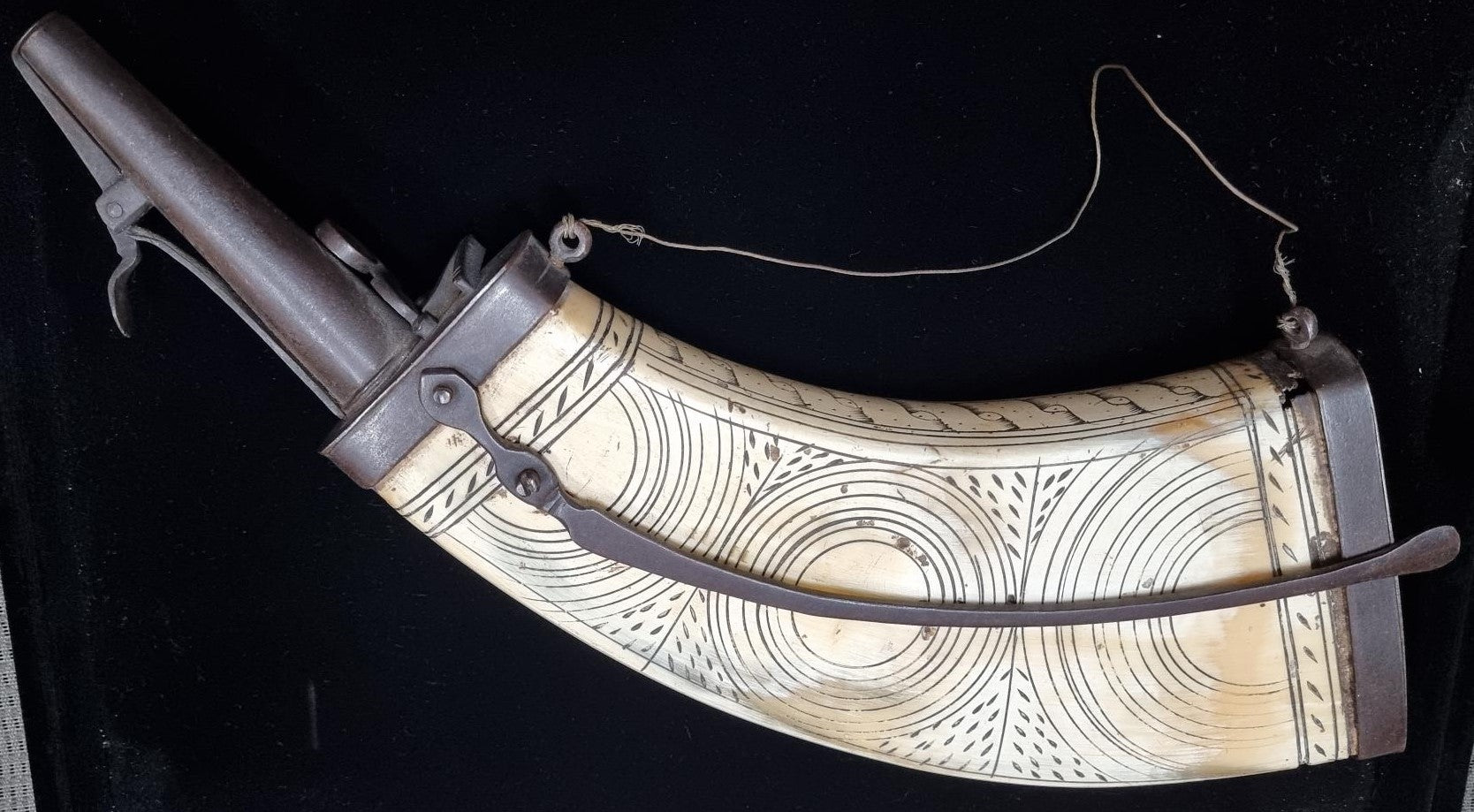

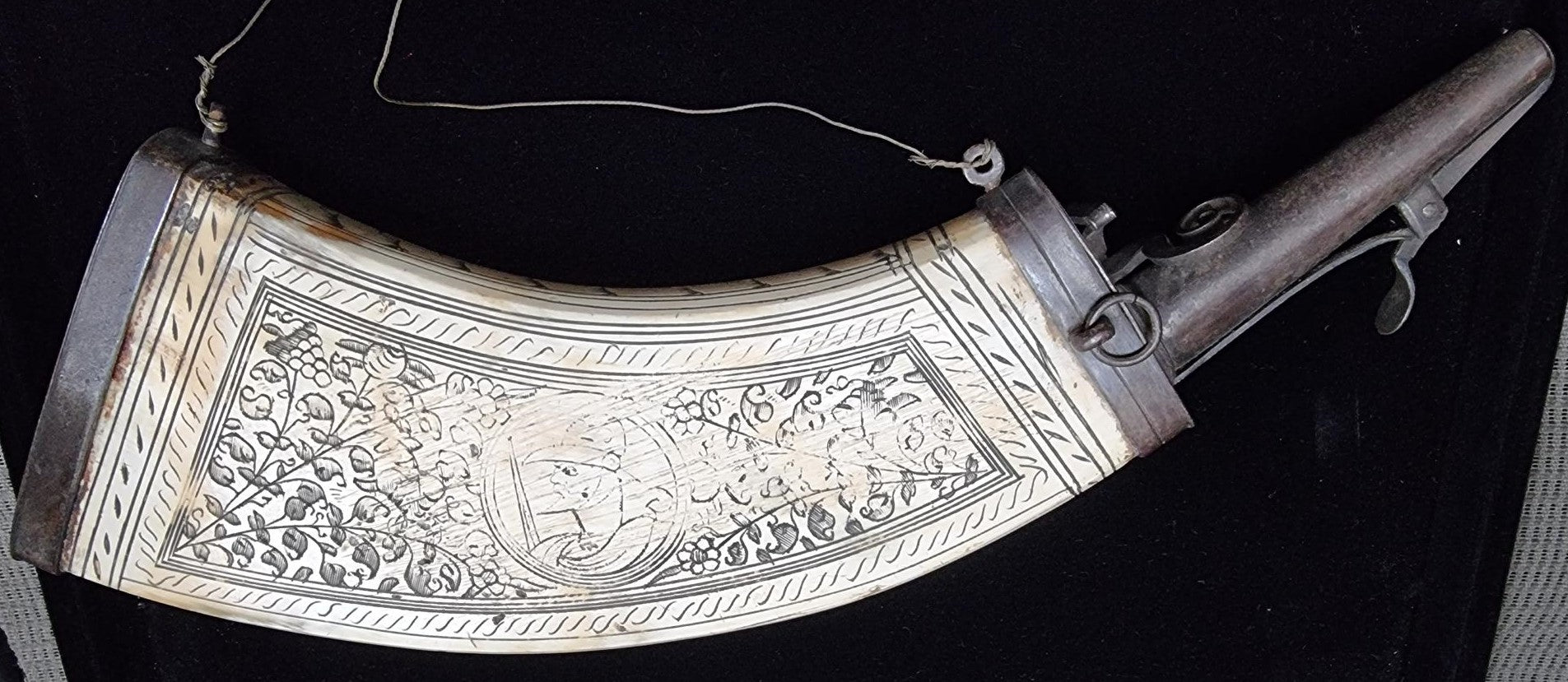

A mid to early 17TH CENTURY GERMAN POWDER FLASK, of characteristic flattened horn form, with iron mounts, the sides decorated with foliage and Vignette of huntsman, the rear decorated with panels of concentric circles dating it to circa 1620.
Originally purchased from PETER DALE in London 40 years ago.
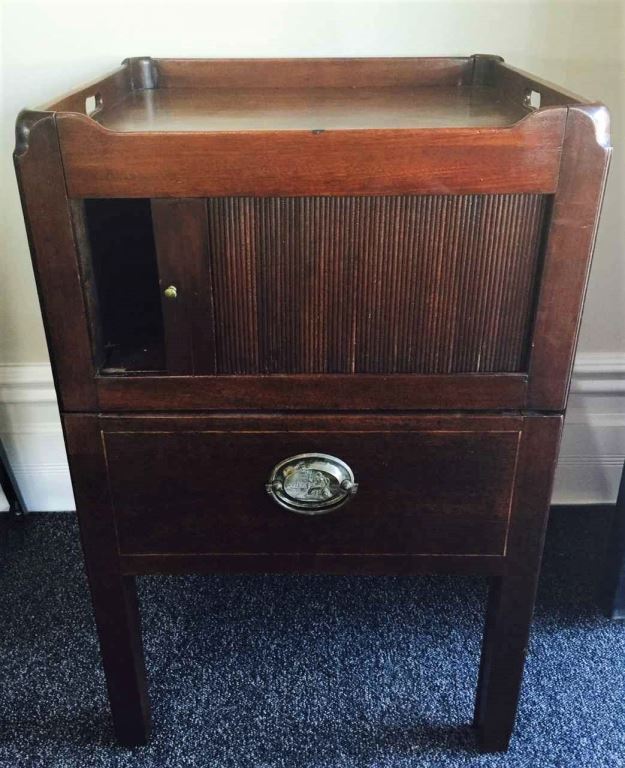

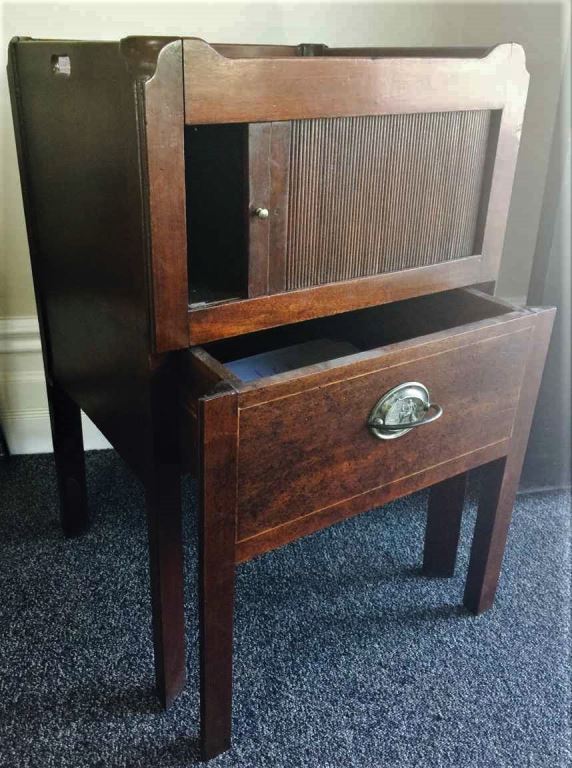

A PERSONAL ITEM OF FIELD MARSHALL WILLIAM BIRDWOOD
A late 18th Century George 111 Commode which has been converted to a bedside cabinet or small writing desk. The significance of this piece is that it was formally the property of Lord Birdwood (Field-Marshall the Lord William Birdwood, GCB, GCSI, GCMG, GCVO, CIE, DSO. Barron Birdwood of Anzac and of Totnes). Lord Birdwood had family in Western Australia and the grand-daughter sold a number of his personal effects in a Gregson’s Auction in 1991.
Galleried top with cut out handles. Tambour front and in the Chippendale style. Comes complete with Auctioneers letter of provenance and some research. It was even suggested that this item went ashore at Gallipoli among Birdwood’s smaller items of creature comfort.
Good condition $6750
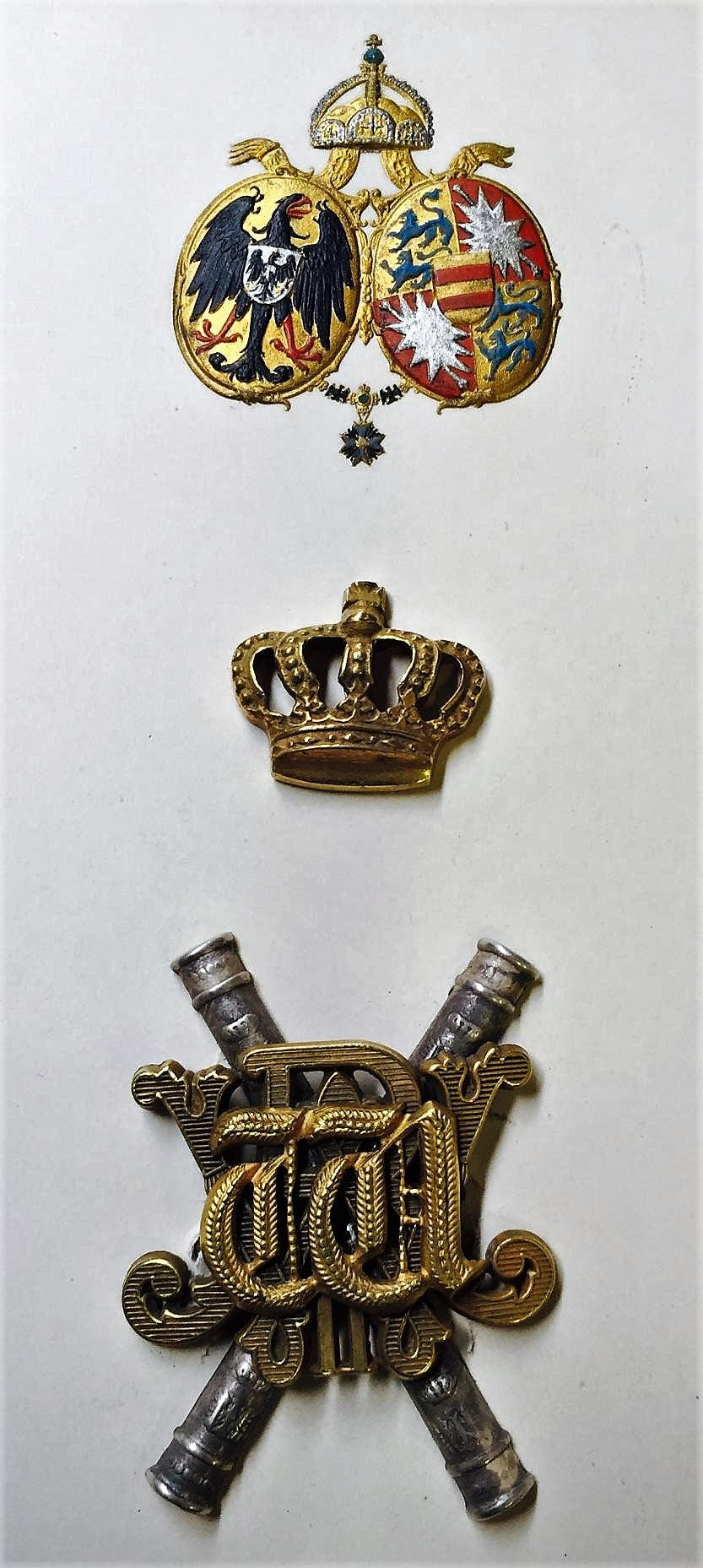
Extremely rare personal rank insignia for KAISER WILHELM 11 on an original pattern card with embossed gilt and colour cypher of the Emperor and Empress.
This insignia not only has the crown over the cypher but also the crossed batons signifying a Prussian General Field Marshal.
It is understood that this insignia was worn on the Field grey uniform of 1915 for the No.1 Regiment Konig-Jager (cavalry).
Extremely rare and in exceptional condition. $1685
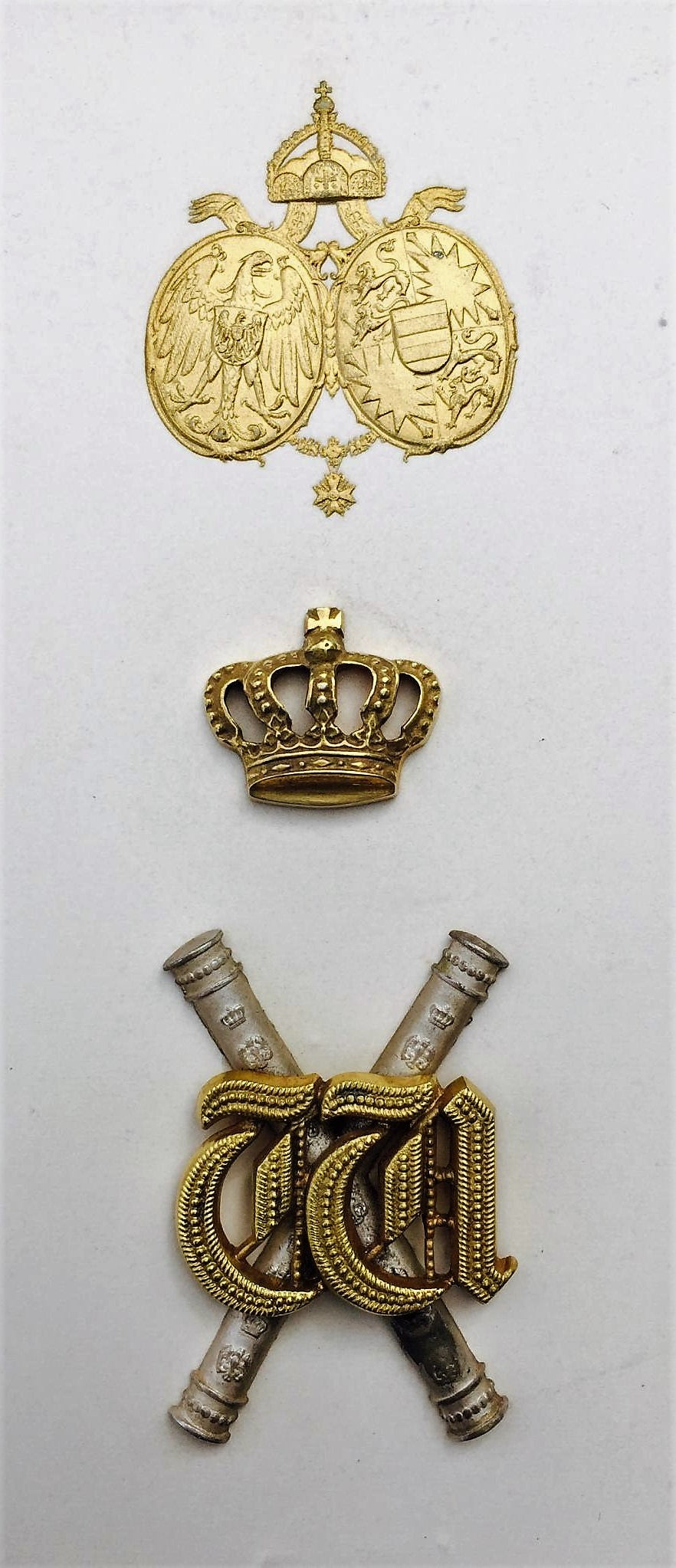
Extremely rare personal rank insignia for KAISER WILHELM 11 on original pattern card with embossed gilt cypher of the Emperor and Empress.
This insignia not only has the crown over the cypher but also the crossed batons signifying a Prussian General Field Marshal.
It is understood that this insignia was worn on the Field grey uniform of 1915 and could be classed as a general pattern.
Extremely rare and in exceptional condition. $1585
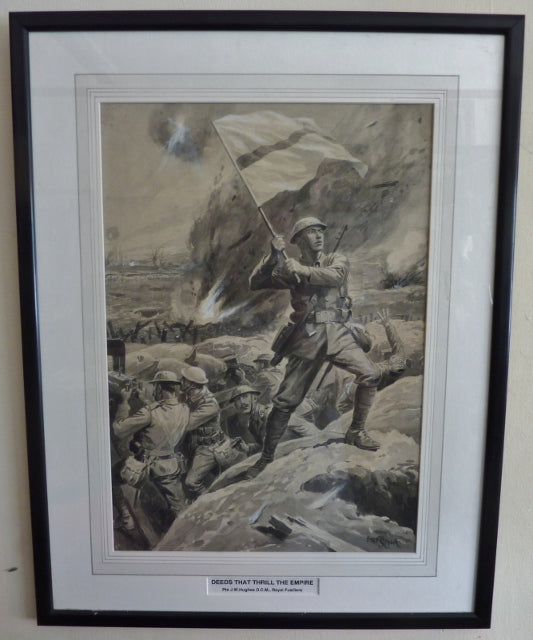

Original artwork from the well known book "Deeds That Thrilled The Empire". Artwork signed John F. Campbell deplicting Private J. W. Hughes Royal Fusilliers winning his DCM. Size displayed 13.5 inches by 19.25 inches. Originally purchased from London Stamp exchange over 25 years ago. These original works rarely come on the market.
Very Good condition $1850
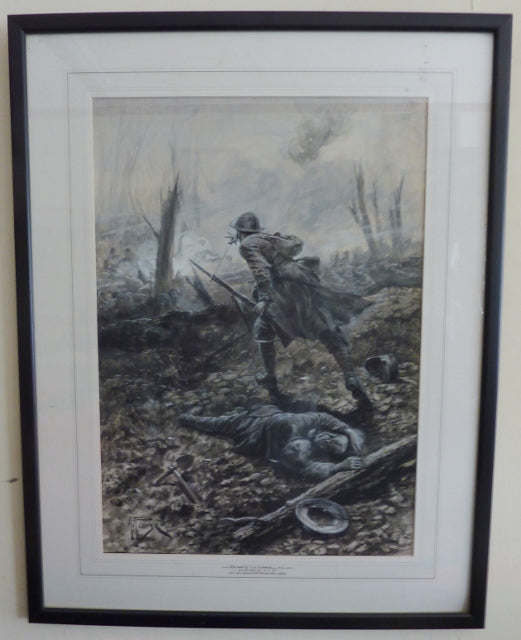

Original artwork from the well known book "Deeds That Thrilled The Empire". Artwork signed A. Pearse deplicting Private T. G. Turrall 10th Bn. Worcestershire Rgt. winning his Victoria Cross at La Boiselle 3/7/1916. Size displayed 14.25 inches by 20.5 inches. Originally purchased from London Stamp exchange over 25 years ago. These original works rarely come on the market.
Very Good Condition $2250


